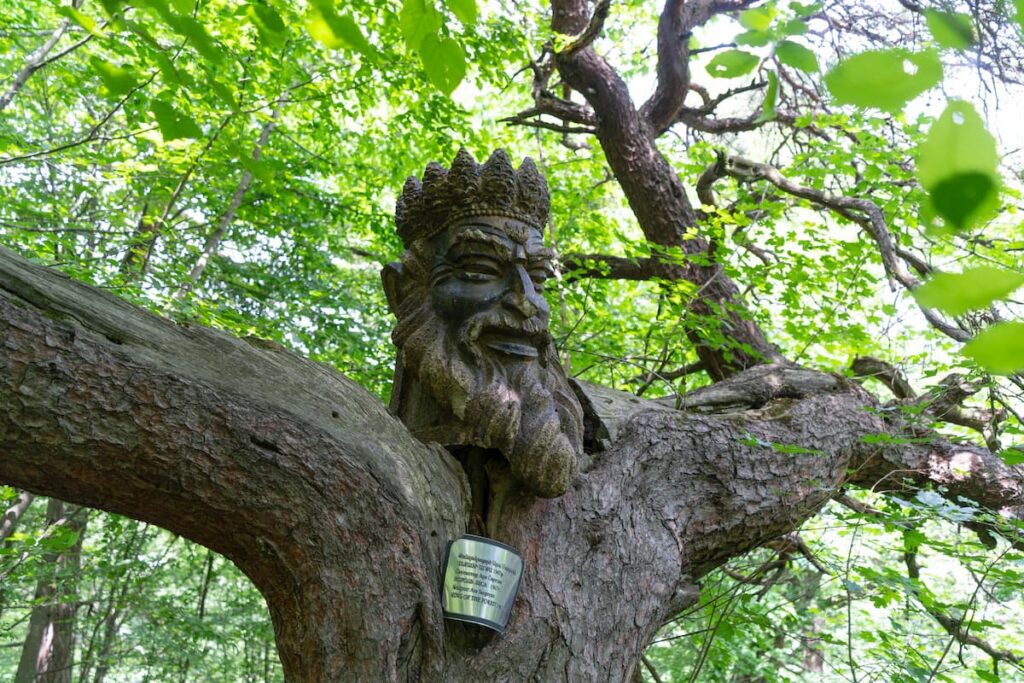
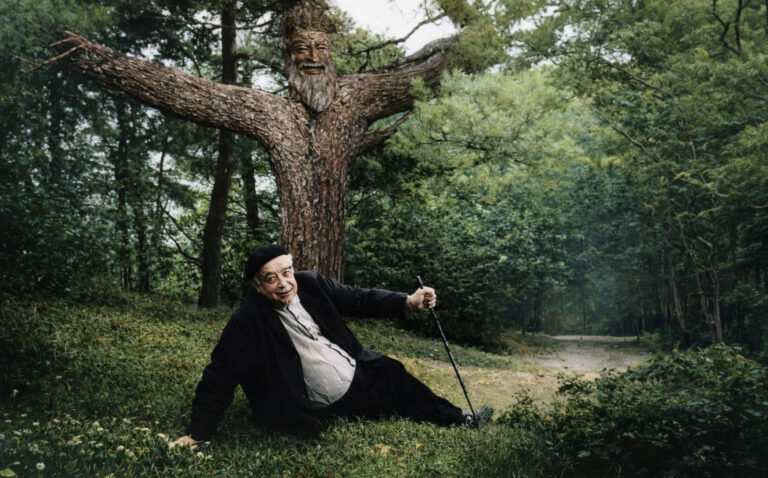
King of forest
The tree was split in two by a lightning strike, giving it its distinctive form.
In 1928, the construction of a villa began near the tree at the initiative of Agasi Khanjyan, and it later became known as Khanjyan’s Villa. Sculptor Ara Sargsyan often visited Dilijan and knew the area very well.
Struck by the tree’s unusual and expressive shape, Sargsyan returned to the villa in 1967. He brought with him a sculpted head made of volcanic tuff. With the help of local residents, the sculpture was placed among the branches, turning the tree into a unique blend of nature and art.
Artistic and Institutional Context
The sculpted face is closely linked to Ara Sargsyan’s earlier work.
In 1923, while studying at the Vienna Academy of Arts, he created a wooden head inspired by a satyr from Greek mythology that figures traditionally associated with forests, nature, and vitality.
Art historians note clear similarities between this earlier work and the expression of the King of the Forest, particularly in its lively character and distinctive features.
The King of the Forest is located near Khanjyan Villa, an architectural structure built in the late 1920s.
Today, both the building and the surrounding land are owned by the Ministry of Education, Science, Culture and Sport (MoESCS), which will determine the villa’s future.
At the same time, Green Rock has supported its preservation by funding site studies, organizing public hearings with the Dilijan Municipality, and submitting conservation recommendations.